
Human Body Sensor or Light Sensor for Solar Garden Lights?
1. Introduction
With the rising demand for energy conservation, environmental protection and intelligent outdoor lighting, solar garden lights have become mainstream outdoor lighting equipment for residential yards, public parks, and commercial landscapes. Modern solar garden lights are usually equipped with two core sensors: light sensors (photocells) and human body motion sensors (infrared sensors). The light sensor automatically identifies ambient light intensity to realize automatic on and off of the light, while the human body sensor detects human activity to trigger intelligent lighting. The combination of the two sensors effectively reduces unnecessary power consumption, extends the service life of the lamp, and improves the safety and convenience of outdoor environments. This article systematically sorts out the typical usage scenarios of dual-sensor solar garden lights and provides practical selection suggestions for different users.
2. Working Principle of Light Sensor and Human Body Sensor
2.1 Light Sensor Working Principle
The light sensor is a photosensitive electronic component that relies on ambient illuminance to control the switch state of solar garden lights. During the day, when the sunlight is sufficient and the illuminance exceeds the preset threshold, the sensor automatically cuts off the lighting circuit, and the lamp stops working and enters the charging state. At dusk, as natural light weakens and the ambient brightness drops to the induction threshold, the light sensor activates the standby mode of the lamp. This sensor realizes fully automatic day charging and night standby without manual operation, which is the basic intelligent configuration of solar garden lights.
2.2 Human Body Motion Sensor Working Principle
Most solar garden lights adopt passive infrared (PIR) human body sensors. These sensors can capture the infrared heat radiation emitted by the human body. When a person enters the detection range of the sensor, the infrared signal changes, and the sensor instantly triggers the lighting function. After the person leaves the induction area and the signal disappears, the light will automatically turn off after a delay of 10 to 60 seconds. Different from constant lighting lamps, human body induction lamps only light up when people pass by, which greatly saves battery power and prolongs the nighttime standby time of the equipment.
3. Typical Usage Scenarios of Dual-sensor Solar Garden Lights
3.1 Private Residential Courtyards
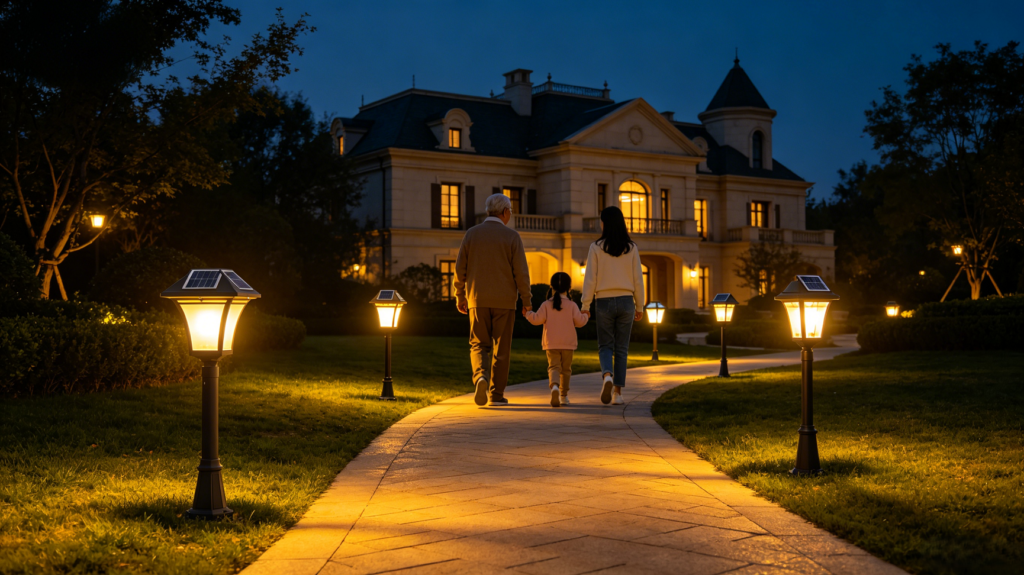
Residential yards are the most common application scenarios for dual-sensor solar garden lights. For family courtyards with lawns, flower beds and independent corridors, the light sensor keeps the lights off during the day for charging, and enters the standby state at night. When residents walk through the courtyard path or approach the garden area at night, the human body sensor triggers soft lighting to avoid stumbling in the dark. In addition, the sudden lighting can deter stray animals and illegal intruders, improving the safety of private residences. For small-sized home courtyards, lamps with short induction distances (3-5 meters) are sufficient to meet daily lighting needs.
3.2 Public Parks and Leisure Green Spaces
Public parks, community green belts and suburban leisure trails have high requirements for energy saving and maintenance convenience. Dual-sensor solar garden lights are perfectly suitable for these scenarios. The light sensor adapts to the natural light changes of the open outdoor environment, avoiding frequent switching caused by subtle light changes. The human body sensor activates the lights only when pedestrians pass by, which reduces long-term continuous power consumption. It is worth noting that park trails usually require lamps with a long detection range (10-20 meters) and a wide induction angle to cover curved paths and dense greening areas. Meanwhile, the soft light will not affect the resting of nocturnal creatures in the green space.
3.3 Villa Driveways and Parking Areas
Driveways and outdoor parking spaces need high-brightness auxiliary lighting and anti-theft monitoring functions. Solar garden lights equipped with dual sensors can automatically turn on the standby mode at night. When vehicles or pedestrians enter the driveway, the sensors quickly induce human and vehicle movement to turn on high-brightness lights, clearly illuminating road conditions and parking positions. For large private parking areas, it is recommended to select lamps with a detection range of more than 20 meters to ensure that every moving area can be covered. The delayed turn-off function also provides sufficient lighting for users to get off the car and walk.
3.4 Commercial Landscape and Tourist Attractions
Commercial landscapes such as resort gardens, scenic walking paths and hotel outdoor leisure areas focus on both decorative and practical lighting. Dual-sensor solar garden lights can adjust the brightness mode according to the environment: they keep low-brightness dim light at night to decorate the landscape, and automatically switch to high-brightness lighting when tourists pass by. The light sensor can adapt to the complex light environment of scenic spots (such as decorative lights and street lamps), avoiding misjudgment of light intensity. Moreover, the solar power supply mode reduces the wiring cost of scenic spots and meets the green energy-saving requirements of commercial places.
3.5 Rural Roads and Remote Outdoor Areas
Rural non-main roads, farmland surrounding roads and remote suburban areas lack municipal power supply and manual maintenance. Dual-sensor solar garden lights do not rely on wired power supply, and the intelligent induction mode minimizes battery loss. The light sensor is not affected by urban light pollution and can accurately identify day and night. The human body sensor lights up when villagers walk or ride at night, effectively solving the lighting problem of remote roads. The waterproof and dustproof design of industrial-grade lamps can adapt to harsh outdoor weather such as strong wind, heavy rain and frost.
4. Key Selection Suggestions for Dual-sensor Solar Garden Lights
4.1 Select Sensor Parameters According to the Use Area
The induction range and angle are the core parameters of sensor selection. For small spaces such as family balconies and miniature courtyards, choose lamps with an induction distance of 3-5 meters and an induction angle of 90° to avoid frequent false triggering caused by excessive sensitivity. For large-area spaces such as large yards, parks and driveways, it is recommended to select products with an induction distance of 15-33 meters and a wide angle of 120°-180° to expand the monitoring coverage. It is necessary to avoid pursuing an excessively long induction range blindly, as it may cause false induction triggered by stray cats, dogs and other small animals.
4.2 Pay Attention to Light Sensor Sensitivity and Adaptability
Different usage environments have different light interference degrees. Urban residential areas are affected by street lamps and building lights, so it is necessary to select light sensors with adjustable sensitivity to prevent the lamps from failing to turn on normally due to strong ambient light. For remote rural areas with weak light pollution, ordinary fixed-threshold light sensors can meet the demand. In addition, high-quality light sensors can resist extreme weather interference and maintain stable identification accuracy in rainy, foggy and cloudy days.
4.3 Focus on Lamp Durability and Protection Level
Solar garden lights are exposed to the outdoors for a long time, so the protection level directly determines the service life of the sensors and the whole lamp. It is recommended to select products with an IP protection level of IP65 or above. Lamps with IP65, IP67 and IP68 ratings have excellent waterproof, dustproof and weather resistance, and can work stably in high temperature, heavy rain and cold winter environments. The shell should be made of anti-aging ABS or aluminum alloy materials to prevent sensor failure caused by shell aging and damage.
4.4 Match Brightness and Battery Configuration Reasonably
The brightness of dual-sensor solar garden lights is usually between 50-800 lumens. Decorative landscape lights are suitable for low brightness (50-200 lumens), while traffic and security lighting need high brightness (300-800 lumens). In terms of battery configuration, lithium batteries with high energy density are preferred. It is better to choose products that can work continuously for more than 3 rainy days to avoid power failure caused by insufficient solar charging in bad weather. Meanwhile, high-efficiency monocrystalline silicon solar panels can improve the charging speed and make up for the power consumption of frequent sensor triggering.
4.5 Optimize Installation Position to Improve Induction Efficiency
During installation, avoid shielding the solar panel with trees, buildings and shelters, and ensure 6-8 hours of direct sunlight every day to guarantee sufficient power storage. The installation height is recommended to be 2-3 meters. Too high installation will reduce the induction sensitivity, while too low installation will narrow the detection range. The sensor probe should face the walking channel and active area to reduce induction blind spots. In addition, keep the sensor surface clean, and regularly wipe the dust and dirt on the probe to avoid affecting the induction accuracy.
5. Conclusion
The combination of light sensor and human body sensor endows solar garden lights with intelligent, energy-saving and efficient performance, covering diversified usage scenarios from private families to public facilities. When purchasing solar garden lights, users should comprehensively consider factors such as site size, ambient light, weather conditions and usage purposes. It is necessary to reasonably match sensor parameters, protection level, brightness and battery performance, and standardize the installation and daily maintenance. A scientific selection and installation scheme can not only give full play to the advantages of dual sensors, reduce energy consumption and maintenance costs, but also create a safe, comfortable and beautiful outdoor lighting environment.